




BIS Certification for Stabilized Hydrogen Peroxide: Complete Guide to ISI Mark, Process, Documents & Compliance in India
BIS License for Stabilized Hydrogen Peroxide | ISI Certification, BIS Registration, Testing Requirements, Cost & Approval Process for Manufacturers and Importers
With the increasing demand for industrial chemicals across sectors such as textiles, paper, pharmaceuticals, water treatment, electronics, and chemical manufacturing, regulatory compliance has become essential for manufacturers and importers operating in India. One such important industrial chemical is Stabilized Hydrogen Peroxide, widely used for bleaching, oxidation, disinfection, sterilization, and industrial processing applications.
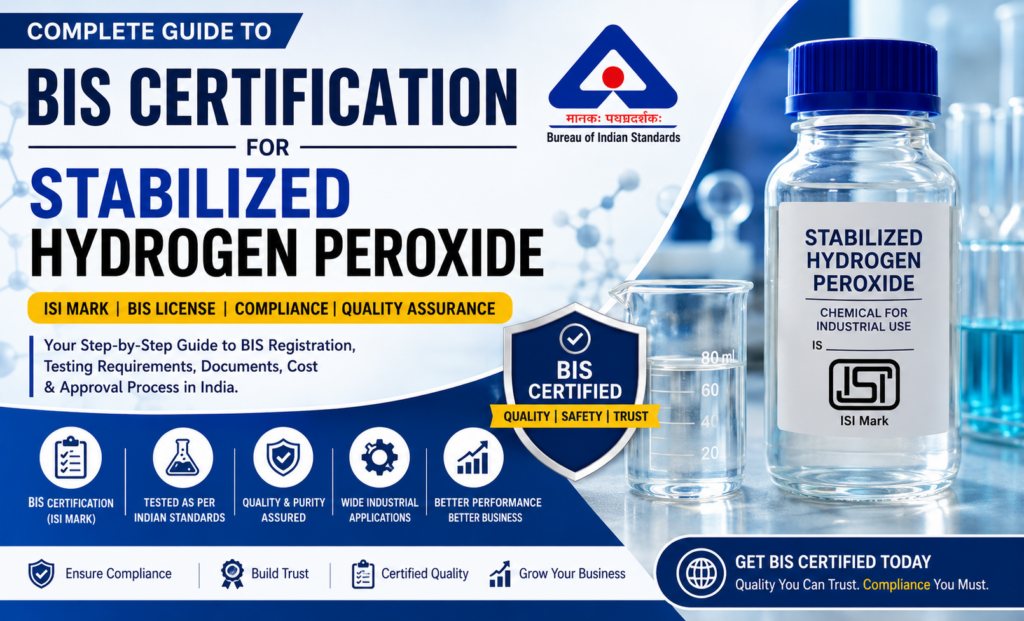
To ensure product quality, safety, and compliance with Indian standards, businesses often require BIS Certification for Stabilized Hydrogen Peroxide. Obtaining a BIS License and ISI Mark Certification helps manufacturers and importers improve market credibility, meet regulatory requirements, and legally sell certified products in India.
This detailed guide covers:
- BIS Certification process for Stabilized Hydrogen Peroxide
- ISI Mark requirements
- BIS registration procedure
- Product testing requirements
- Documents required
- Certification cost and timeline
- Compliance requirements for manufacturers and importers
- Benefits of BIS approval
What is Stabilized Hydrogen Peroxide?
Stabilized Hydrogen Peroxide is a chemically treated form of hydrogen peroxide designed to maintain stability during storage, transportation, and industrial use.
It is widely used in:
- Textile bleaching
- Paper and pulp industries
- Water treatment plants
- Pharmaceutical manufacturing
- Chemical processing
- Electronics cleaning
- Disinfection and sterilization applications
Due to its industrial importance and chemical nature, maintaining proper quality standards becomes extremely important.
What is BIS Certification?
BIS (Bureau of Indian Standards) is the national standards authority of India responsible for maintaining product quality, safety, and standardization.
BIS certification ensures that products comply with applicable Indian Standards before being sold in the Indian market.
Products approved by BIS are permitted to use:
- ISI Mark
- BIS Standard Mark
The ISI Mark for Stabilized Hydrogen Peroxide indicates that the product has passed required quality and safety checks.
Importance of BIS Certification for Stabilized Hydrogen Peroxide
Obtaining BIS Certification for Industrial Chemicals offers multiple advantages for manufacturers and importers.
1. Regulatory Compliance
BIS certification helps businesses comply with:
- Indian quality standards
- Government regulations
- Applicable Quality Control Orders (QCOs)
2. Product Quality Assurance
Certification ensures the product meets required:
- Purity standards
- Stability requirements
- Chemical specifications
- Safety parameters
3. Enhanced Market Credibility
Industrial buyers prefer BIS-certified chemical products because they ensure:
- Reliable quality
- Consistent performance
- Safer industrial usage
4. Better Business Opportunities
Many industrial procurement departments and government tenders prioritize:
- BIS-certified manufacturers
- ISI-marked products
5. Competitive Advantage
Certified businesses gain stronger market positioning compared to uncertified suppliers.
BIS License for Stabilized Hydrogen Peroxide
Manufacturers seeking to use the ISI Mark must obtain a valid:
- BIS License
- Product certification approval
This license confirms compliance with Indian quality standards and testing requirements.
Is BIS Certification Mandatory for Stabilized Hydrogen Peroxide?
Whether certification is mandatory depends on:
- Government notifications
- Applicable Quality Control Orders
- Industry-specific regulations
Manufacturers and importers should regularly monitor BIS notifications related to:
- Industrial chemicals
- Chemical product compliance
- Mandatory BIS certification requirements
Even when not mandatory, obtaining BIS certification significantly improves business trust and industrial acceptance.
BIS Certification Process for Stabilized Hydrogen Peroxide
The certification process generally includes the following steps.
Step 1: Documentation Preparation
The applicant prepares:
- Factory documents
- Product specifications
- Manufacturing process details
- Quality control records
- Laboratory testing details
Step 2: BIS Application Submission
The manufacturer submits:
- BIS application forms
- Required supporting documents
- Applicable government fees
Step 3: Product Testing
Samples are tested in BIS-recognized laboratories.
Testing may include:
- Chemical purity testing
- Stability analysis
- Concentration testing
- Impurity analysis
- Safety parameter evaluation
Testing is mandatory for:
- BIS approval
- ISI Mark Certification
Step 4: Factory Inspection
BIS officials inspect the manufacturing facility to verify:
- Production process
- Quality control systems
- Manufacturing capability
- Testing infrastructure
Step 5: Grant of BIS License
After successful inspection and testing, BIS grants:
- Certification approval
- Permission to use the ISI Mark
Documents Required for BIS Certification
The following documents are commonly required.
Company Documents
- Business registration certificate
- GST certificate
- Factory license
- Trademark certificate (if applicable)
Manufacturing Documents
- Manufacturing process flow chart
- Machinery details
- Plant layout
- Raw material details
Quality Documents
- Internal test reports
- Quality assurance procedures
- Laboratory information
Additional Documents
- Authorized signatory ID proof
- Product specification sheet
- Application forms
BIS Testing Requirements for Stabilized Hydrogen Peroxide
Testing is one of the most critical stages in the BIS certification process.
Testing generally evaluates:
- Hydrogen peroxide concentration
- Stability performance
- Impurity levels
- Residue analysis
- Safety compliance
- Chemical consistency
Testing must be conducted in:
- BIS-approved laboratories
- Recognized testing facilities
BIS Certification Cost for Stabilized Hydrogen Peroxide
The total certification cost depends on:
- Product category
- Number of variants
- Testing fees
- Inspection charges
- Consultant fees
- Annual marking fees
The cost structure generally includes:
- Application fee
- Product testing fee
- Audit fee
- BIS license fee
Time Required for BIS Certification
The certification timeline usually depends on:
- Documentation readiness
- Laboratory testing duration
- Factory compliance
- BIS inspection schedule
Generally, the process may take:
- 30 to 90 days
Delays commonly occur due to:
- Incomplete documentation
- Failed test reports
- Non-compliance during inspection
BIS Certification for Importers
Importers supplying Stabilized Hydrogen Peroxide in India should verify:
- Whether BIS certification is mandatory
- Applicable import compliance rules
- Product testing requirements
Imported products without proper BIS compliance may face:
- Customs clearance delays
- Product restrictions
- Regulatory penalties
- Sales limitations
Therefore, importers should ensure proper:
- BIS registration
- Certification approval
- Compliance documentation
before importing products into India.
BIS Certification for Industrial Chemicals
Industrial chemical manufacturers increasingly seek:
- BIS approval
- ISI certification
- Product compliance
This improves:
- Product credibility
- Industrial trust
- Procurement opportunities
- Regulatory acceptance
Benefits of ISI Mark Certification
The ISI Mark for Stabilized Hydrogen Peroxide indicates:
- Standardized quality
- Reliable industrial performance
- Regulatory compliance
- Product safety assurance
It also improves:
- Customer confidence
- Brand reputation
- Market acceptance
- Business growth opportunities
Role of BIS Consultants
Many businesses hire professional BIS Consultants for:
- Documentation preparation
- Application filing
- Product testing coordination
- Audit preparation
- Compliance management
An experienced BIS consultant helps reduce:
- Approval delays
- Documentation errors
- Compliance risks
Common Challenges in BIS Certification
1. Incomplete Documentation
Improper paperwork may delay approval.
2. Product Testing Failure
Products not meeting required standards may require reformulation.
3. Factory Compliance Issues
Weak quality systems may lead to inspection observations.
4. Lack of BIS Process Knowledge
Improper understanding of the certification process often causes delays.
Why Businesses Prefer BIS-Certified Chemical Products
Industrial buyers increasingly prefer BIS-certified suppliers because certification ensures:
- Standardized quality
- Reliable performance
- Regulatory compliance
- Safer industrial usage
This significantly improves:
- Business reputation
- Customer trust
- Procurement approvals
- Market competitiveness
Frequently Asked Questions (FAQs)
What is BIS Certification for Stabilized Hydrogen Peroxide?
It is a quality certification issued by BIS confirming compliance with Indian standards and product safety requirements.
Is BIS certification mandatory for Stabilized Hydrogen Peroxide?
The requirement depends on applicable government notifications and Quality Control Orders.
How long does BIS certification take for Stabilized Hydrogen Peroxide?
The process generally takes between 30 to 90 days.
What are the benefits of ISI Mark certification?
ISI certification improves product credibility, quality assurance, and industrial acceptance.
Can imported Stabilized Hydrogen Peroxide be sold without BIS certification?
If the product falls under mandatory BIS compliance, certification becomes compulsory before sale in India.
What documents are required for BIS certification?
Required documents generally include:
- Factory license
- GST certificate
- Manufacturing details
- Quality control records
- Product specifications
Conclusion
Obtaining BIS Certification for Stabilized Hydrogen Peroxide is essential for manufacturers and importers seeking quality compliance, industrial credibility, and regulatory approval in India.
Whether you are a:
- Manufacturer
- Importer
- Supplier
- Industrial distributor
having a valid BIS License and ISI Mark Certification can significantly improve your market reputation and business opportunities.
With increasing focus on industrial safety and product standardization, businesses should proactively ensure BIS compliance to remain competitive and legally compliant in the Indian market.
Course Features
- Real-life Practice Studies
- Real-life Case Studies
- Assignments
- Lifetime Access
- Expert Support
- Global Certification
- Job Portal Access

Register yourself to grow your knowledge
© 2026 DigiManthan Technical Training Institute - All Rights Reserved.